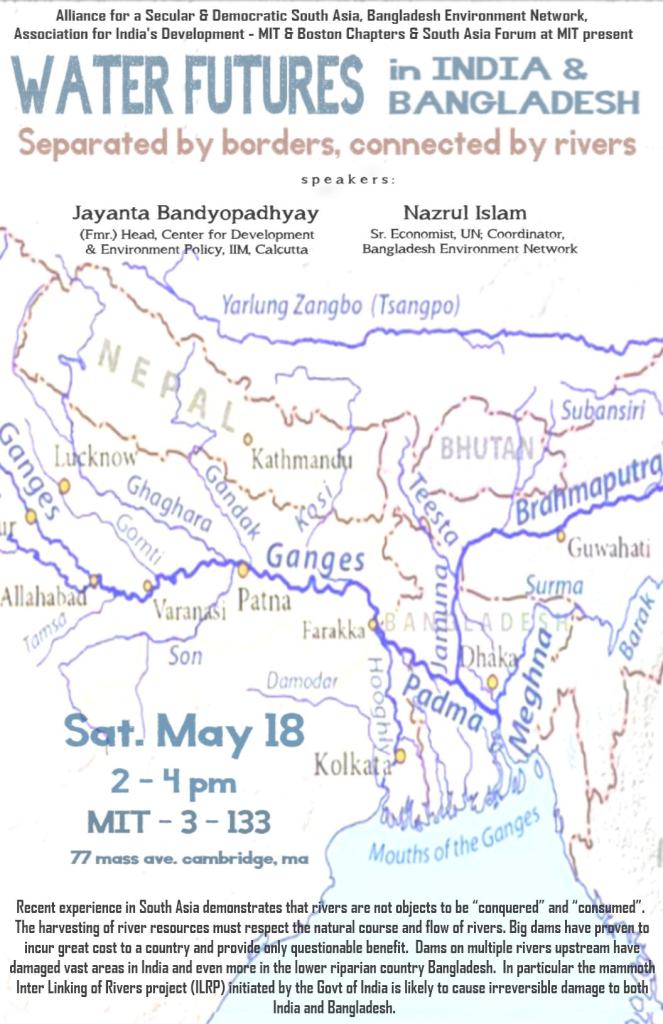
Water Future of Bangladesh and India: Divided by borders, connected by rivers

Saturday 2-4 pm, May 18, 2013

MIT Room 3-133
http://whereis.mit.edu/?go=3

Speakers: Jayanta Bandyopadhyay and Nazrul Islam

Jayanta Bandyopadhya, environmental activist and professor, author of fourteen critically acclaimed books, is the former head of the Center for Development and Environment Policy at the Indian Institute of Management Calcutta.

Nazrul Islam, the senior economist at the UN, is the author of several books on prospects for development in Bangladesh and China. He is the coordinator of Bangladesh Environment Network ( BEN ), a global organization of Bangladeshi citizens, expatriates, and friends of Bangladesh dedicated to protecting the environment in Bangladesh.

Recent experience in South Asia demonstrates that rivers are not objects to be “conquered” and “consumed”. The harvesting of river resources must not entail fundamental changes to the natural course and flow of rivers.

Big dams have proven to incur great costs to a country and provide only questionable benefit. Dams on multiple rivers upstream have damaged vast areas in India and even more in the lower riparian country Bangladesh.

In particular, the mammoth Inter Linking of Rivers project ( ILRP ) initiated by the Govt of India is likely to cause irreversible damage to both India and Bangladesh.

Organized by:

Alliance for a Secular and Democratic South Asia (www.southAsiaAlliance.org)

Association for India’s Development MIT & Boston Chapters (www.aidboston.org)

Bangladesh Environment Network (www.ben-global.org)

The South Asia Forum at MIT

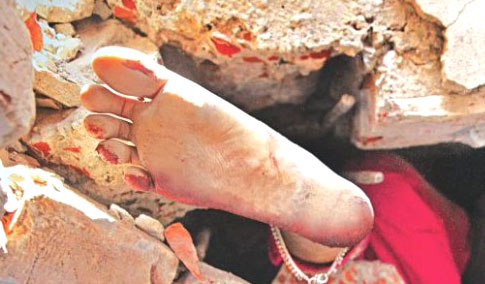
Vigil/picket For Bangladeshi workers killed in the April 25th Rana factory collapse – May 4, 2013

Speech by Nurul Kabir, poem read by Padma Balasubramanian below.

Thanks, everybody for being here today. It is a great day, a beautiful day and I am happy to be here with all of you!

And I remember that no more than a few days ago, at 9 AM in the morning on the other side of the world, in Bangladesh, a nine-story building had collapsed, with 5000 workers in it. And people died.

People died. People died cruelly. With their limbs stuck under the rubble. They had no food and water for over four days. They died in anguish thinking of their infants that they had left behind, the father and the mother that they could no longer support with their meager earnings.

They died because they were made to go back into a building that was in danger of collapse. They died because their managers forced them to go in and work. They died for a job that paid $40 a month.

Now, since 2006 there have been over a thousand such deaths. We as consumers in the west do have responsibility. Because those people died making the clothes we wear.

They are being killed because in the chain connecting us to them something is amiss. Something is amiss because we know that for every garment piece that is sold at $100 in the western market, the governments of the consuming countries in the west earn more than $25 in tax, the retailer in the west makes $50 and of the rest, nearly $24 go to the owner’s profit and costs, and a worker gets less than $1.

[Shouts of “Shame” from people assembled at vigil]

Now, the multi-national companies say that “Look, we don’t have any responsibility, because we are contracting to sub-contractors and them to sub-contractors”. They work in cooperation with the government [in the outsourced country}. And the government supports the owners of the factories. The police are on their [owner’s] side, the administration is on their side. Till today not a single factory owner has been punished. The workers, on the other hand, have no unions. They do have industrial police, recently formed, not to protect them but for the express purpose of “keeping order” in the factories.

Now, this is an old story. In 1995, Gap made shirts in El Salvador. They sold for $20 outside. The worker got 18 cents. Men, women, children! toiled in sweatshop hell for 14 hours a day. Some formed a union. The subcontracting factory fired them. Others went on strike. At the end of the year, Gap said we are moving to Asia.

The multi-national companies say this: “Look, if you don’t behave yourselves we will move away. We will leave El Salvador and we will go to Bangladesh, from Bangladesh we will go to Haiti. Why will go to the moon if you don’t behave”.

So how are we to protect poor working people’s rights on this world?

Well, the first thing we have to realize is that the multi-national corporations aren’t about to go to the moon, there are no workers there, not yet. They live on this planet, where WE live and die.

For me, the way is that nowhere in the world should somebody be made to go back to burning buildings, collapsing buildings. If the rights of all workers are upheld, then in the so-called race to the bottom, there is a bottom below which we can’t go to.

So generally if we look at the alliances in the whole supply chain that gives us a guide of where we are and where we should be. There are the alliances between the multi-nationals and the governments, and the works, perhaps, with us.

And specifically, of course, and I say this specifically too certain aggrieved members of the Bangladeshi “Community” :

We do not undertake any action that is not in concert with working people’s express demands.

Understand?

We work in humility. We know that we are not the workers themselves. In unity, we see what the workers want, and to the best of our ability, we will give them our support.

If we do that, I think, we can achieve the goal that we – all of us – want. Which is: “The people united will never be defeated”

[Chorus of slogans from the people assembled at vigil]

Poem Read by Padma Balasubramanian

Your feet are raised toward Bangladesh

By Ali Riaz, translated for AlalODulal.org by Tibra Ali

The music of your anklets used to ring out in your mother’s yard and your own home

Your upturned hands used to rise up in prayer

That was yesterday

That was when we sold your tears and sweat for cheap

You were extremely useful to us

Useful in terms of dollar value,

Useful in terms of international trade,

Useful for the governmental statistics

More than once, your face and your dedication to work I have used,

After creasing out the folds and wrinkles, to represent Bangladesh in brightly-lit seminar rooms.
Fund Raising for families of Bangladesh Garment Workers killed by Fires

The Alliance for a Secular and Democratic South Asia raised $7,000 for the families of garment workers affected by the Tazreen garment factory fire of November 2012.

This effort in no way absolves the Government of Bangladesh and the class it represents their criminal abdication of responsibility towards the workers. Nor does it weaken our commitment to support the workers in the demand for their rights.

The Alliance expresses immense gratitude to all who contributed to the fundraising effort and their support for the ongoing campaign for workers’ rights.

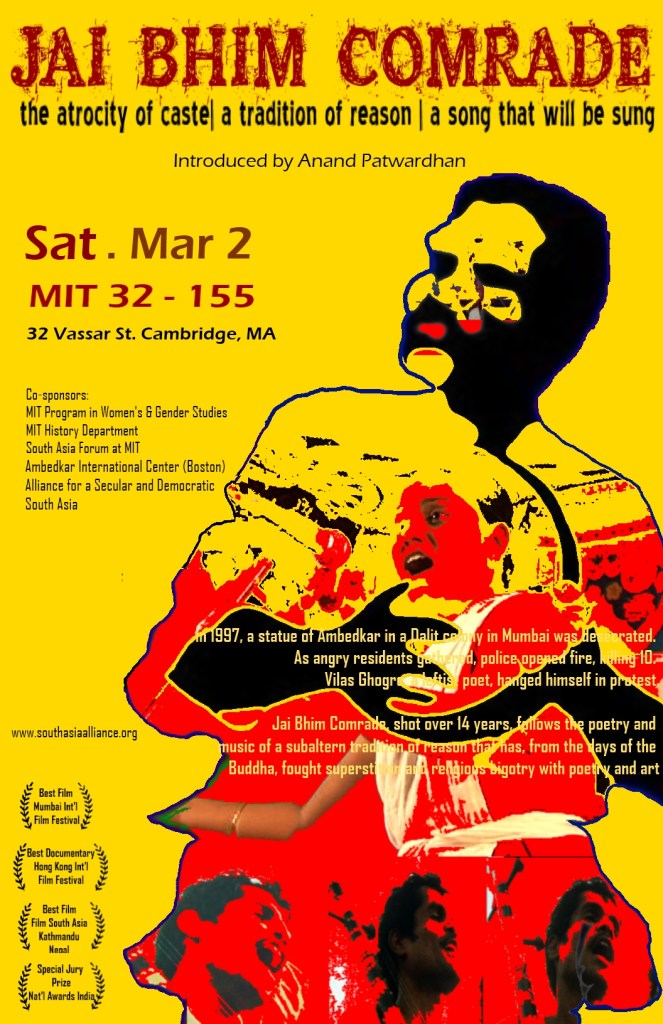
JAI BHIM COMRADE – Mar 2, 2013

The Atrocity of Caste | a Tradition of Reason | A Song that will be Sung

Introduced by Anand Patwardhan

Sat. Mar 2, 2013, 2 – 6pm MIT 32 – 155

Followed by QA with the Director

Co-sponsored by:

MIT Program in Women’s and Gender Studies
MIT History Department
South Asia Forum at MIT

Ambedkar International Center (Boston)
The Alliance for a Secular and Democratic South Asia

JAI BHIM COMRADE

In 1997, a statue of Ambedkar in a Dalit (Untouchable) colony in Mumbai was desecrated. Ambedkar was a central figure in the Dalit liberation movement in India. As angry residents gathered, police opened fire, killing 10. Vilas Ghogre, a leftist poet, hanged himself in protest.

Jai Bhim Comrade shot over 14 years, follows the poetry and music of a subaltern tradition of the reason that has, from the days of the Buddha, fought superstition and religious bigotry with poetry and art.

With their mix of revolutionary politics and Dalit liberation, the artists’ collective Kabit Kala Manch has been subject to intense state repression. Many of the artists featured in the film are now underground to escape arrest. For more info visitwww.kabirkalamanch.wordpress.com

Anand Patwardhan has been making investigative documentaries in India for over four decades. His films have often faced state censorship and the wrath of religious fundamentalists.

South Asian Women Panel Discussion – Feb 27, 2013

The Program in Women’s & Gender Studies

The South Asia Forum at MIT

The Alliance for a Secular and Democratic South Asia

Cordially invite you to a panel discussion

South Asian Women Resist Religious Fundamentalism, Imperialism, and The State in Bangladesh, India, and Pakistan

with Nusrat Chowdhury, Modhumita Roy, Afiya Zia

Wednesday, February 27, 2013

6:30-8:30PM

Bldg 4-231 MIT

Afiya S. Zia is a feminist researcher and activist based in Karachi, Pakistan. She is author of ‘Sex Crime in the Islamic Context’, 1994; ‘Watching Them Watching Us’, 2001 (ASR, Pakistan), and has edited a series of books and contributed to scholarly journals. She is currently working on a book titled ‘Faith and Feminism in Pakistan’. She is an active member of Women’s Action Forum – a secular women’s rights organization in Pakistan and is an advisory board member of the Centre for Secular Space (UK).

Nusrat Chowdhury is an Assistant Professor of Anthropology at Amherst College. Her research focuses on the protest movement against open-pit coal mining and everyday ethical negotiations in a place called Phulbari in northern Bangladesh. The confrontations between the state and the people, the intimacy of corruption and development, and the nature of democratic thought and practice in a country like Bangladesh make Phulbari a fecund site where discourses of political crisis and energy crisis intersect and shape each other.

Modhumita Roy is Associate Professor of English at Tufts University. She works on Anglophone literature of Africa and the Africa Diaspora, South Asian Literature, Literature of Empire, Post-colonial Theory, Feminist Theory, and Literary Theory. Her article, “Some Like it Hot: Gender, Class, and Empire in the Making of Mulligatawny Soup” was awarded the Sophie Coe Memorial Prize by the Oxford Symposium on Food and Cookery, St. Catherine’s College, Oxford, UK. She is currently working on commercial surrogacy in India.

Event Open to Public

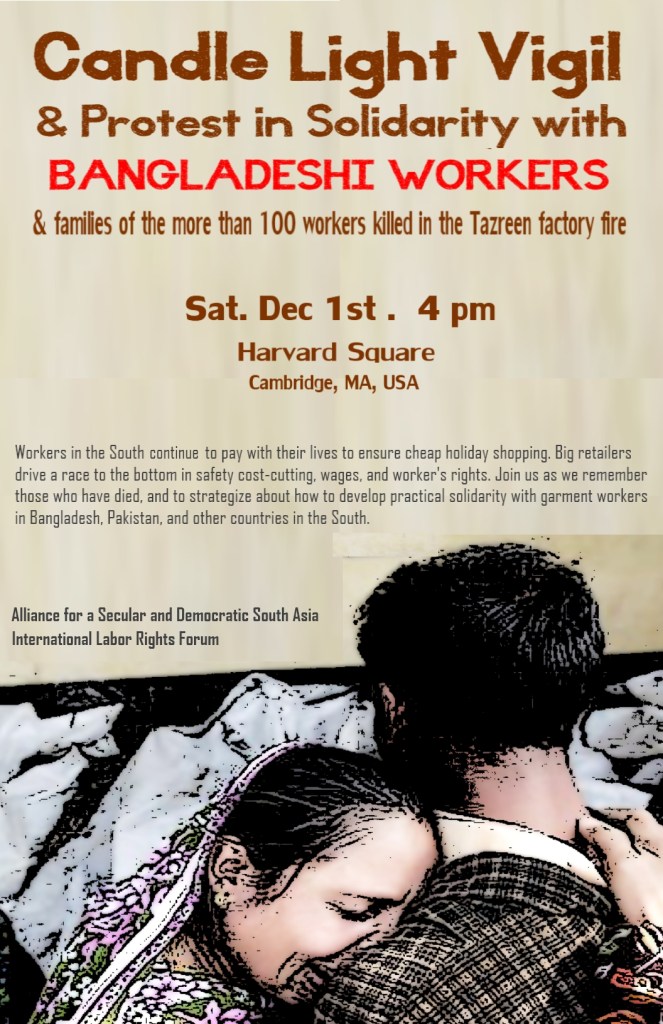
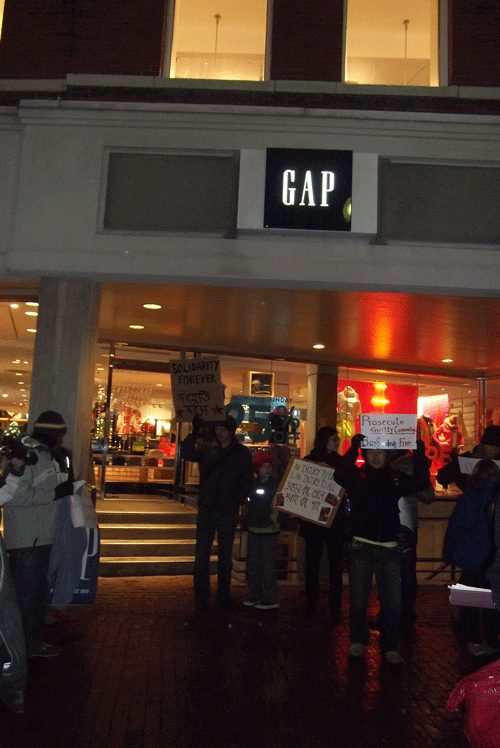
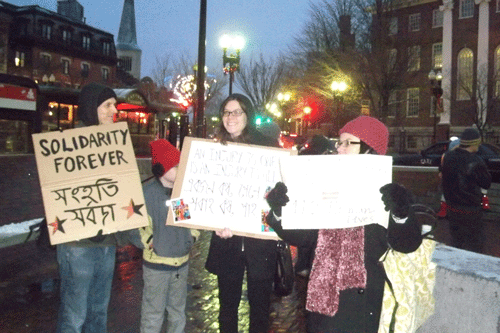
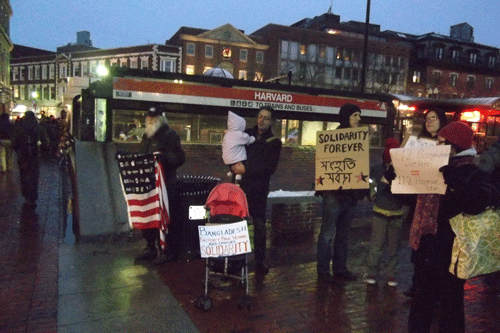
Protest held in Harvard Square for Tazreen Garment Factory fire in Bangladesh – Dec 1, 2012


Press Release post-Vigil YouTube videos:

http://m.youtube.com/watch?v=1OtVbaJZG3Y
http://m.youtube.com/watch?v=rIHfRZ7kLAk

Activists and community members from various parts of the Boston-area took part in a protest vigil at Harvard Square earlier this month. Roughly 35 people attended. The vigil was called by the Alliance for a Secular and Democratic South Asia and supported by several social justice groups, including the International Labor Rights Forum.

Protesting the Bangladesh Garment Factory Fire at Harvard Square

by Umang Kumar, Alliance for a Secular and Democratic South Asia (Advocate), Dec-09-12

International Op-ed

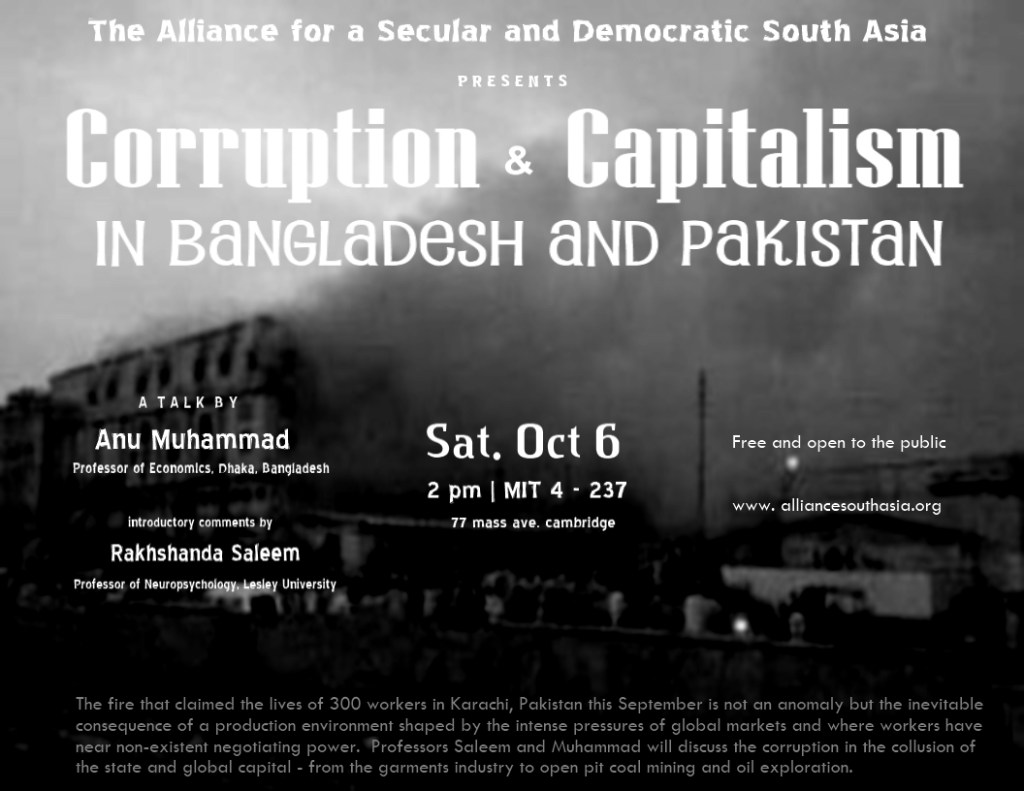
As a member of the Alliance for Secular and Democratic South Asia (“Alliance”), a Cambridge, MA-based organization that champions issues in South Asia, the news of the November 24th Tazreen garment factory fire in Dhaka Bangladesh in which 112 workers lost their lives was a rude jolt. It was also a reminder that such things seem sickeningly repetitive. Only in October, the Alliance had organized a panel discussion called “Corruption and Capitalism in Bangladesh and Pakistan,” which dealt with the incident of fire this September that claimed the lives of 300 garment workers in Karachi, Pakistan. In the blurb of that event, we had written that “Such an incident is not an anomaly but the inevitable consequence faced by workers with near non-existent negotiation powers in Bangladesh and Pakistan.” On this occasion, faced with another horrific incident, the Alliance decided to come out to the streets, as it were, to hold a candle-light vigil and protest rally at Harvard Square on Dec 1st.

We were joined in our efforts by representatives from several organizations, notably the International Labor Rights Forum (ILRF) and the Association for India’s Development (AID). We felt it was important to highlight issues of the voicelessness of the garment workers and their exploitation. It was important to protest against the exploitation of the actual creators of the product who, at the bottom of the value chain, make a pittance while the middlemen and the owners skim off the obscene profits.

It was also important to be able to raise our voices against the obscuration that the modern processes of capitalism and supply-chain manufacturing entail which are designed towards obscuration, obfuscation, and shirking and dilution of responsibilities. We, who are from South Asia, cannot forget the case of the Bhopal gas leak in 1984 where even when the Indian-owners of a US multinational was involved and later that corporation was taken over by another US-based corporation, Dow Chemical, the issue of liability has been fractious and has more recently been dragging on in courts for 28 years now, with Dow Chemicals refusing to accept the liabilities of Union Carbide. With the off-shoring of the manufacturing jobs to the lowest bidder, major multinational corporations like Walmart, the GAP and H&M could care less about pay structures and safety measures in the outfits they contract to. So the vigil was a way to articulate and reiterate such forms of deliberate negligence that have fatal consequences for the human beings who are ensnared in such an exploitative system.

We felt it was important to highlight the fact, especially in this holiday season, that the clothes and dresses that we buy from stores that seem to be offering cheap prices – all have very high human costs associated with them. To that end, we had actual items of clothing during the vigil which had messages such as, “Walmart Is Cheap? Ask Bangladeshi Workers,” pinned on them. For us, it was crucial to emphasize the “Cheap=Deadly” equivalence as the more than 1000 deaths in the garment industry in Bangladesh, according to a report by ILRF, bears out – not to mention comparable numbers in other such manufacturing hells in other countries in South Asia and also the world. Marx, of course, elucidated the concept of commodity fetishism which was a fundamental fact of the modern capitalist mode of production, but the transnational nature of outsourcing takes the abstraction of relations between the capitalists and the workers to another level of obscuration, such that the drops of blood after every tragedy never seem to stain the clean shirts of executives in their boardrooms.

Umang Kumar is an activist with the Alliance for a Secular and Democratic South Asia.