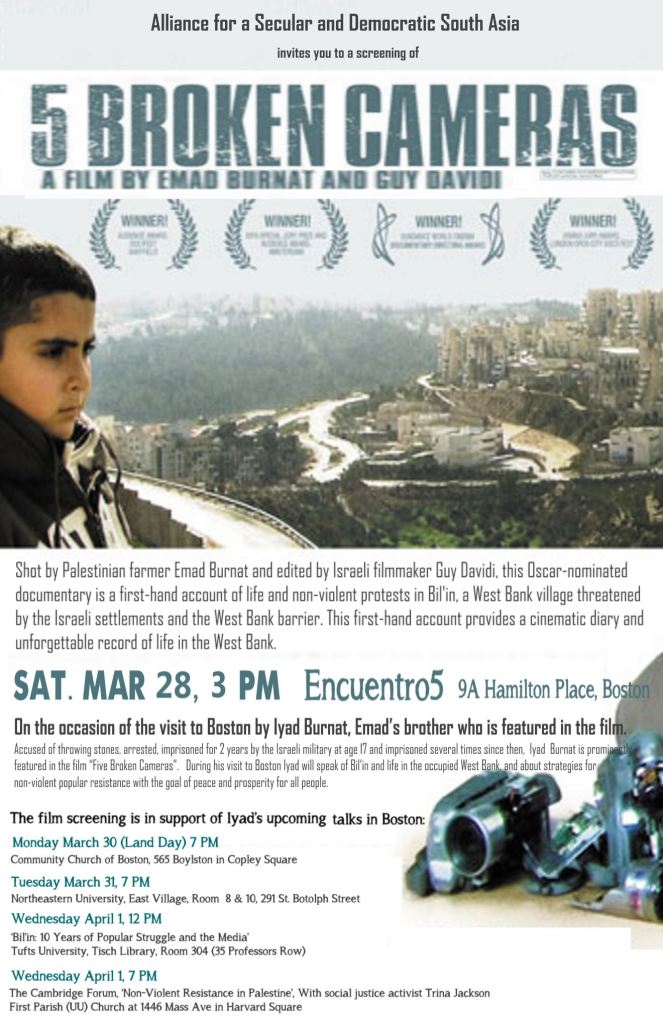
5 Broken Cameras – Iyad Burnat March 28 – April 1, 2015
The Alliance for a Secular and Democratic South Asia unequivocally condemns the murder of Avijit Roy on February 26, 2015, on the streets of Dhaka, Bangladesh.
Dr. Avijit Roy was a naturalized American citizen of Bangladeshi origin. An engineer by profession, he wrote on themes related to science, philosophy, religion, and society. More than a decade ago he founded a popular internet forum Mukto-Mona (Open Mind) that has been a strong voice against religious intolerance.
His last two books (written in Bangla) are on cosmology (titled “Universe out of Nothing”) and on the friendship between Rabindranath Tagore and the Argentinian writer Victoria Ocampo. “The Philosophy of Atheists” and “The Virus of Faith”, also written in Bangla, focused on science, religion, and rationalism. For the thoughts that were espoused in these books and in Mukto-Mona, Avijit Roy received several death threats last year, including the warning that he would be killed upon his return to Bangladesh.
In accordance with the threat, Avijit Roy was killed ten days after his arrival in February 2015, on a public street with knives and machetes in full view of onlookers. His wife Rafida Ahmed Banna was also attacked. Currently, she is in critical condition in a Dhaka hospital.
The murder of Abhijit follows the same pattern as in the earlier killings of blogger Rajib Haider (February 2013), Prof. Shafiul Islam of Rajshahi University (November 2014), Prof. Yunus (also of Rajshahi University) (December 2004), and the attack on Prof. Humayun Azad of Dhaka University (February 2004).
The Alliance for a Secular and Democratic South Asia is alarmed by the killing of free-thinking intellectuals, clearly aimed at stifling secular and creative thinking, and call upon all to condemn these crimes. We implore citizens of Bangladesh, organizations, and political parties, in power or in opposition, to work together and fight against extreme religious orthodoxy that has resulted in the heinous killing of Dr. Avijit Roy.
We cordially invite you to a lecture/discussion on
Surveillance, Profiling, and Exclusion: The Murky Politics of an Identification Project (UID)
by Usha Ramanathan
Thursday, November 20
6:30PM, MIT Room 4-145
Usha Ramanathan works on the jurisprudence of poverty. She writes and speaks on issues such as the Bhopal gas disaster, mass displacement, and eminent domain. She has been monitoring the Unique Identification project in India has written extensively on the subject. In July-September 2013, she wrote a 19-part series on the UID project that was published in The Statesman, a national daily.
Sponsored by:
The Alliance for a Secular and Democratic South Asia
The South Asia Forum at MIT
Seminar by GAUTAM NAVLAKHA
Room 3-333, MIT
4PM, SUNDAY, AUGUST 3
About the Speaker: Gautam Navlakha is a civil liberties activist working for the non-funded People’s Union for Democratic Rights (Delhi) and was associated with the Economic and Political Weekly for more than three decades. He lives in Delhi and has written extensively on issues of democratic rights and civil liberties in India. His recent book, Days and Nights in the Heartland of Rebellion, was published by Penguin India in 2012.
The event is co-sponsored by South Asia Forum, MIT; Alliance for a Secular and Democratic South Asia; and Sanhati.
The Alliance for a Secular and Democratic South Asia
July 30, 2014
The Alliance for a Secular and Democratic South Asia condemns in the strongest possible terms the State of Israel’s war on the Palestinian population in Gaza.
In a campaign of territorial expansion on the pretext of self-defense, Israel rains artillery fire and bombs on children, women, and men in Gaza, an area the size of Manhattan with 1.8 million inhabitants.
The people of Gaza have no army, air defense, navy, heavy weapons or artillery units. Over 80% live below the poverty line. The population is held in permanent, collective detention, with vital medical and aid supplies withheld on a routine basis.
Israel wages its war against such a captive population. In violation of all norms of humanity and international laws, Israel has destroyed Gaza’s only power plant, hospitals, apartment complexes, and shelled UN schools where more than 200,000 people have been forced to take shelter.
This onslaught on the Palestinians is the most recent phase of the decades-long campaign to ethnically cleanse Palestine.
The Alliance for a Secular and Democratic South Asia calls upon the South Asian diaspora to undertake actions in solidarity with the Palestinian people – to take part in the international campaign to boycott Israel, in demonstrations condemning the attack on Gaza and to work towards the long term goal of securing for the Palestinian people their right to live in peace and dignity.
Our Pledge
April 2014
India goes to polls this year. Amnesia about Gujarat 2002 and a media BJP hype with Narendra Modi as the candidate for prime minister who “get things done” makes immediate once again the threat of resurgent communalism in India. This is not to be taken lightly in the view of recent history.
With Narendra Modi as chief minister, Gujarat in 2002 underwent a well-planned pogrom that took the lives of 2000 people and made homeless over 100,000. Savagery unleashed upon the minority Muslim population saw kerosene-soaked people set on fire, women raped and mutilated on the streets, children tossed into fires. The authorities were complicit.
Modi’s party, the BJP, aided and abetted by the RSS (Rashtriya Swayamsevak Sangh), mobilized people in the name of Hinduism. Gujarat 2002 is consistent with the statement of the founder of the RSS, the patron group of the BJP. Their ideology as stated by their founding father incorporates divisiveness that bodes ill for any society: The non-Hindu people of Hindustan must either adopt Hindu culture and languages, must learn and respect and hold in reverence the Hindu religion, must entertain no idea but of those of glorification of the Hindu race and culture… in a word they must cease to be foreigners; Or may stay in the country, wholly subordinated to the Hindu nation, claiming nothing, deserving no privileges, far less any preferential treatment— not even citizens’ rights”
Only two election cycles later, both of which the BJP lost, we are asked to “forgive-and-forget” the pogrom of 2002. People are in return promised that an economic success engineered in Gujarat by Modi will be applied nation-wide. Gujarat is to be a model for growth in India’s economy. Never mind that this much-touted “Gujarat Success” is marginally better than the average in other states of the country and is no departure from the current national paradigm of growth for India as a whole: growth for the few at the cost of many. Modi’s party, the BJP, rules in other states in India as well and the reports from those states are no more encouraging. BJP propaganda persists in deluding people with the promise of a bright economic future by a PM whose ideology and politics are imbued with hate-mongering and is certain to wreak havoc.
As in prior elections, the people of India may well see through the ‘Gujarat Shining’ motif once again, and the poll-seers in India proved wrong again.
Regardless, the prospect of a BJP victory in the elections is of grave concern to all who see secularism as an integral part of democracy worldwide. By the same token that we as US resident immigrants and minorities would not wish for the formation of a Christian state here, we are alarmed at the prospect of a ‘Hindu Rashtra’ in India that would further marginalize and threaten minorities there.
Our pledge to uphold secularism is therefore not only for the year’s election. It is for all time.
A discussion with Aviva Chomsky, Anu Muhammad, Ed Childs
Saturday, January 11, 2014, 3 PM
MIT – Room 4-237
77 Mass Ave
Cambridge, MA
Free and Open to the Public
In the global South workers and peasants fight starvation wages and plunder of natural resources; in the North austerity for workers and bailout for capitalists have become a dominant phenomenon. As most nation-states continue to collude with global capital, people’s movements grow for a just and sustainable world. The speakers will review recent examples in Bangladesh, Colombia, and the US and the prospects for real democracy and global solidarity.
Aviva Chomsky is a historian, author, and activist. She teaches at Salem State University in Massachusetts and her activism and academic work include the development of the global working class, immigration in US, and mining in Colombia.
Anu Muhammad is an activist and professor of economics at Jahangirnagar University in Bangladesh. His research work and activism include globalization and energy, specifically mining and garment workers issues in Bangladesh.
Ed Childs is an activist and leader in UNITE HERE! and International Action Center, a cook at Harvard and a participant in Occupy Boston. UNITE HERE represents workers throughout the U.S. and Canada who work in the hotel, food service, manufacturing, textile, laundry, and airport industries.
Sponsors:
Alliance for a Secular and Democratic South Asia ( http://www.SouthAsiaAlliance.org )
Bangladesh Workers Solidarity Network ( http://www.BangladeshWorkersSolidarityNetwork.org
Mass Global Action (http://www.massglobalaction.org )
MIT Western Hemisphere Project (http://web.mit.edu/hemisphere/ )
The Life of Revolutionary Possibility in India
The Alliance for a Secular and Democratic South Asia
invites you to a screening of Red Ant Dream
The Life of Revolutionary Possibility in India – A documentary by Sanjay Kak
Sat. Dec. 7, 2013
3 pm
MIT Building 3, Room 270,
77 Mass Ave Cambridge
Director/Producer Sanjay Kak will introduce the film and will answer questions after the screening
An armed insurrection simmers in Bastar, central India; in the east beleaguered adivasis from the mineral-rich hills of Odisha attempt to protect their land with axes; in the north protests by Punjabi peasants call upon the iconic figure of Bhagat Singh, martyr of the anti-colonial struggle.
Red Ant Dream, Sanjay Kak’s latest film, studies the possibilities of people’s revolt in India. It joins an impressive body of work looking at how the state and the powerful have colluded across the nation to silence peaceful protest, Tanushree Bhasin, in Sunday Guardian.
Sanjay Kak is an independent documentary filmmaker whose recent work reflects his interests in ecology, alternatives and resistance politics. “Red Ant Dream” is a film about the Maoist rebellion in East-Central India. It is the third in a series of films that interrogate the workings of Indian democracy and highlight peoples’ resistance movements. His earlier films in this genre are “Jashn-e-Azadi” (How We Celebrate Freedom) about the struggle for Azadi – freedom – in Kashmir, and “Words on Water” about the struggle against large dams in the Narmada Valley in Central India. He is based in New Delhi.
Aseem Shrivastava
Sunday, October 6th, 5PM
Room 26-168, MIT
About the talk: Taking its cue from the recent Uttarakhand flash-floods disaster in northern India, the talk will examine the socio-economic and ecological impact of globalization in India. The mind-set of globalized development mentality that India’s elites have now come to believe in can only worsen, in the long-run, prevailing conditions of poverty, unemployment, inequalities, and environmental devastation. Do Indian elites have the courage and vision to suspend an unsustainable business-as-usual and build a new India, respectful of nature, and the urgent needs of hundreds of millions? India is uniquely placed by the facts of history and destiny to serve as the world’s ecological pioneer – if only it would surrender its present “corporate nationalism” and stop misunderstanding its role in the world as an aspiring superpower.
About the speaker: Aseem Shrivastava is a Delhi-based writer and ecological economist. He wrote his doctoral thesis in Environmental Economics at the University of Massachusetts, Amherst. He has taught economics for many years at college and university level in India and the US. Most recently, he taught philosophy at Nordic College, Norway. He has written extensively on issues associated with globalization. He is the author (with Ashish Kothari) of Churning the Earth: The Making of Global India (Penguin India, 2012, http://churningtheearth.in/).
Sponsored by: Association for India’s Development (Boston and MIT chapters) and Alliance for a Secular and Democratic South Asia.
Free and Open to All
Facebook Event: https://www.facebook.com/events/522800417800965/
Alliance for a Secular and Democratic South Asia
p r e s e n t s
India: An Urban Battleground – a talk by Dr. Parthosarathy Ray
FRI. JUL 26 | 6:30 pm
MIT Building 4, Room 237
77 Mass Ave, Cambridge
About
Over the last decade or so, the focus of most activists and organizations in India has been mostly on the countryside, where large scale displacement and land grab has been going on in the interests of national and multinational capital. However, in the meantime, the urban conflict over land, over the right to the city, and over proper working and living conditions has also become more and more intense.
Actually, the conflicts in the rural areas and urban areas are interlinked by economics and the commonality of class interests. At the fundamental level, this battle, beyond the rhetoric on urban development and beautification, on rights and rehabilitation, on investment and industrialization, is class conflict. It is a conflict between the urban working class and the bourgeoisie, and the basic question in contention is the “right to the city”. In some places the conflict is taking the shape of slum eviction and resistance to it, in others, it is reflected in the militant action of unorganized labor.
The contours of this conflict are going to shape the future nature and the character of the cities in India, where most of the economic activity in the country is already concentrated, and understanding and developing a proper response to it is therefore of immense importance to all of us.
Bio
Partho Sarothi Ray is a professor in the Department of Biological Sciences at the Indian Institute of Science Education and Research, Kolkata. He has been active in the anti-displacement movements around India and has been part of the struggles of the urban poor in Kolkata and Bengaluru. He is a founder member of the solidarity forum Sanhati. He was the first activist to do a thorough ground-level reporting of the movement in Lalgarh, West Bengal, and has written extensively on the political economy of contemporary India, especially the political economy of urban struggles.

 Alliance for a Secular and Democratic South Asia